
Μηνιαίες Δραστηριότητες

Athina
Λίγα λόγια για την Τέχνη και την Gestalt μέσα από την οπτική του Buber
Η τέχνη μπορεί να επηρεάσει τους ανθρώπους δυναμικά, να τους συγκινήσει και να τους ενθουσιάσει. Ο Buber χρησιμοποιεί το παράδειγμα της τέχνης για να δείξει πώς η μία διάσταση της πραγματικότητας, η διάσταση του Εσύ, μεταβαίνει στην άλλη, τη διάσταση του Αυτό (Αποστολόπουλος, 1991). Πιστεύει πως η τέχνη έλκει την καταγωγή της από μια οπτασία-έμπνευση που, εμφανιζόμενη στην ψυχή του καλλιτέχνη, απαιτεί να γίνει έργο. Αν ο άνθρωπος (καλλιτέχνης) αναλάβει αυτή τη μετουσίωση και δοθεί με όλο του το είναι στην πρόσκληση, με αυτοθυσία και τόλμη, εάν σχετιστεί με μορφή Εγώ-Εσύ στην οπτασία, τότε εισρέει η δημιουργός δύναμη και γεννιέται το έργο τέχνης. Το έργο τέχνης που δημιουργείται είναι ένα «πράγμα» που μπορεί κανείς να γνωρίσει εμπειρικά και το οποίο έχει συγκεκριμένες (ενδεχομένως σταθερές) ιδιότητες. Εάν για παράδειγμα βιώνεται μια λύπη, εκφράζοντας τη λύπη αυτή με μουσική που παράγει το άτομο πρέπει να περάσει την εμπειρία του σε πράξη εξαντικειμενικεύοντας έτσι το βίωμα της λύπης. Με τον τρόπο αυτό, ό,τι είναι άμεσο στην αρχή χάνει βαθμηδόν την αμεσότητά του καθώς υφίσταται την παρεμβολή διαφόρων μέσων, τίθεται εντός ορίων και μετριέται με σταθμά γενικώς παραδεκτά. Έτσι η δημιουργία τέχνης εξυπηρετεί τόσο την ανάγκη του ατόμου για αυτοέκφραση όσο και για επικοινωνία – κοινωνικοποίηση. Υπάρχει ευτυχώς η δυνατότητα μιας επανα-μεταμόρφωσης της καλλιτεχνικής πράξης από το Αυτό στο Εσύ, όταν π.χ. το άτομο σχετιστεί με τη μουσική με όλο του το είναι σε μια σχέση «I-Thou» και βιώσει σε υπαρξιακό επίπεδο τα συναισθήματα που αυτή εμπεριέχει και εκφράζει. Έτσι προκύπτει το παράδοξο ότι ένα πραγματοποιημένο έργο είναι ταυτόχρονα και απο-πραγματοποιημένο (άνευ πραγματικότητας), καθώς μεταβαίνει από τη σφαίρα του «Εσύ» στη σφαίρα του «Αυτό».
Ο Buber θεωρεί ότι προαπαιτείται κάποιας μορφής ασφάλεια για να έρθει κάποιος σε έναν πραγματικό, ουσιαστικό διάλογο, να μπορέσει να δείξει την ευάλωτη πλευρά του αλλά και να επιτρέψει στον εαυτό του να μετασχηματιστεί από την επαφή με τον άλλον (Buber, 1969·1975· Αποστολόπουλος, 1991). Δε γίνεται να συναντηθεί κανείς σε υπαρξιακό διάλογο με κάποιον άλλον όταν νιώθει φόβο. Η αναγκαία, λοιπόν, αίσθηση ασφάλειας μπορεί να είναι η βάση του σχετίζεσθαι, μια βάση που μπορεί να οδηγήσει σε μια πραγματική επαφή «I-Thou» και να εξυπηρετήσει τις ανάγκες και των δύο πλευρών. Η μουσική διάδραση με νόημα στο πλαίσιο αυτό μπορεί να οδηγήσει σε μεταμορφωτικές εμπειρίες και σε μια αυθεντική διάδραση εφ’ όρου ζωής.
“Let’s Talk About Th’ Erotic Feelings In The Therapeutic Process”
The process of the therapeutic encounter includes connection, provision of care, ex- posure of vulnerability and deep emotional contact between two persons. In this con- text it is natural for erotic feelings to arise, in either of the participants. The erotic feel- ings that emerge in the therapeutic setting, common as they might be, are often left unsaid. Feelings of shame, fear or guilt might lead therapists to secrecy or a selective professional isolation. That makes it difficult to get the support and guidance they need in order to understand, process and develop ways of working with them. More- over, even though several issues concerning sexuality have been in the center of at- tention and public dialogue in the last years, the emergence of erotic feelings in the therapy room remains a subject that is often poorly addressed in training programs and in bibliography. The purpose of this presentation is to create a space where themes surrounding erotic feelings can be shared and explored.
Within the relational framework of Gestalt Therapy theory, whatever emerges between client and therapist, including erotic feelings, is a valuable source of information concerning the therapeutic process. In this theoretical presentation we will explore the field of erotic feelings in the therapeutic relationship, based on our understanding of the relational SOS model by Sally Denham- Vaughan and Marie- Anne Chidiac. We will discuss the Enduring Relational Themes (term comprised by Lynne Jacobs to describe transference) that might be implicated in the emergence of the erotic feelings. We will examine how they might influence the therapeutic interaction, how they might be influenced by the dynamics of the therapeutic relationship and the ethical issues that emerge. We will navigate in the supporting ground of: phenomenological exploration, authentic dialogue, ethical presence of the therapist, existential themes, shared responsibility for the co- creation of contact, intentionality for contact that is inherent in eroticism, awareness of the wider field concerning sexuality and eroticism. Finally, we will suggest ways to work creatively with erotic feelings, integrating their potential to become an agent of change in the therapeutic process.
Gesta(l-r)t: Poiesis: motion - emotion - commotion
“Poiesis" is the procedure through which a person creates something not existing before"
In this workshop, we will try together the procedure of “poiesis”, and, using art as our vehicle, we will co-create what did not exist before. We will observe how a new being (human or other) comes to life, how their character emerges, and most of all we will be there to experiment supporting that being in their life.
How am I? How is this being? How do we meet?
How does that little being face up to social change? How does this fact change me?
Let us find out through playing, reflecting, relating.
Daktila L. Psychologist, Gestalt psychotherapist
Tsiamoura M. MSc Psychology, Gestalt psychotherapist
Integrating Art into Gestalt Psychotherapy: When Tools and Techniques Become the Field for a New Relationship
The integration of art in psychotherapeutic practice has been established for years as an effective intervention that contributes to the recovery and rehabilitation of mental illness. Nevertheless, this integration is often a challenge for mental health professionals, as there is no systematic and reliable way of choosing the appropriate intervention depending on the type of psychological difficulties and the stage of the therapeutic process. On the other hand, Gestalt psychotherapy based on phenomenology and existential dialogue is a suitable field where art and the possibilities it offers can be integrated into the psychotherapeutic process and contribute to the realization of therapeutic goals.
Daktila L. Psychologist, Gestalt psychotherapist
Tsiamoura M. MSc Psychology, Gestalt psychotherapist
CONFERENCE: GIANNI FRANCESETTI (ENGLISH)
GIANNI FRANCESETTI. Gestalt therapy: Attuning on processes in progress.
TRAINING STANDARDS AS AN ENGINE OF CHANGE IN AN UNSTABLE FIELD: RULES AND CREATIVITY
- Silvia Tosi, Why we need Training standards in Gestalt: rules and creativity in a changing world? (coordinator and presenter)
- Elena Lasaja, How to support vitality and competences of trainers in this changing world? (presenter)
- Jevgenyij Kolesznyikov, Possibilities and risks of online training, supervision and therapy (presenter)
- Jack van Liesdonk, My avatar says I am healthy but I feel awful. Differences between standards and contact in the postmodern world. (presenter)
- Despina Balliou, " The whole is greater than the sum of its parts" Aristotle. Can we measure the quality of a training program? Let's challenge the training criteria. (presenter)
Duration of the communication: (10-15' for questions).Technical needs: NOCommunication language: Spanish / EnglishProvide translation: YES
EAGT Training standards committee proposes a round table for everyone who is involved in the training processes to discuss together.
EAGT is an association of members that recognize themselves in certain fundamental principles.
The aims of the EAGT are to assure quality standards of their members. In this way is an international common ground created to operate on. The common ground is created by setting professional standards in ethics, in the competences of gestalt therapists, in the way gestalt therapists and supervisors are trained, and so on.
In a circle of colleagues, we propose the discussion of these actual questions.
- Why we need Training Standards in Gestalt: rules and creativity in a changing world
How to live between the polarities in society like risks and looking for stability. There is an insecurity to go into a process of many years of gestalt training.
Motivation to be part of and participate in the EAGT community can offer some certainty by the feeling of belonging.
Training Standards in Gestalt are an effort to bridge the gap between freedom of art, anarchy and individuality on one hand and regulations, guarantee and safety on the other. It is an effort to bridge the gap between creativity and adjustment to the requirements of the health care market.
- How to support vitality and competences of trainers in this changing world?
- Possibilities and risks of online training, supervision and therapy.
After covid-pandemic we meet more and more online projects in gestalt communities. These events are connecting and disconnecting at the same moment. And what about training standards? How should they develop because of online spread? Could we imagine a gestalt-therapist that never meets clients face-to-face? Could classical training in the room without online skills be enough in contemporary reality? Are hybrid groups the groups? Could training be fully online? Is online therapy a new profession? Should we keep the boundaries or be sensitive to what is born?
- My avatar says I am healthy but I feel awful. Differences between standards and contact in the postmodern world.
- " The whole is greater than the sum of its parts" Aristotle. Can we measure the quality of a training program? Let's challenge the training criteria.
Hours of theory, hours of therapy, hours of supervision and so on!
Just additions? Are additions of specific training standards, like hours, exams and papers sufficient enough to ensure the quality of a training program?
Beyond additions, there are multiplications, substructions, divisions of variables in situation, mutually interacting and influencing the quality of a reliable and effective training program.
Let’s challenge the criteria by raising a fertile dialogue around them.
References:
https://www.eagt.org/joomla/index.php/2016-02-25-13-34-32/trainings-standards-committee
Key words:
Gestalt, Training Standards, Creativity, Professional Standards, Transformation
CV
Silvia Tosi, Clinical Psychologist, Gestalt Therapist and Supervisor (accredited by the EAGT). International trainer at the Istituto di Gestalt HCC Italy. Chair of the Training Standards Committee and member of the Executive Committee, EAGT. Member of the Editorial Board of Quaderni di Gestalt, Franco Angeli Editore and of the Gestalt Therapy Book Series, Routledge
Elena Lasaja,
Jevgenyij Kolesznyikov, M.D. - psychiatrist, EAP accredited gestalt-therapist, EAGT supervisor and officer of Training standards and Research committees, trainer, director of Međunarodni Institut za Geštalt (MIG), Montenegro.
Jack van Liesdonk,
Despina Balliou, B.Sc. Psychology, M.Sc. Counseling Psychology, Gestalt psychotherapist, trainer and supervisor, founding member of the “Gestalt Foundation” Psychotherapy and Training Center – Greece, member of EAGT’s Training Standards Committee, co-author of the book "Introduction to Gestalt Psychotherapy - Basic Concepts, Principles and Applications" (2011).
The Social Dynamics of Human Expression through Art
The relationship we develop as humans with Art has an inherently social aspect, and our expression through it can only be speech and an attitude towards the social change we are experiencing.
The aim of this presentation is the systematic recording and highlighting of tools and techniques that come from the field of visual and performing arts and that have been successfully integrated into the methodology of Gestalt psychotherapy. Utilizing and documenting the multi-year experience (>25 years) of 30 Gestalt psychotherapists and their artist collaborators, a systematic recording of strategies, tools and techniques that have been used in individual or group psychotherapy and have been empirically proven as good practices was made. Detailed reference is made regarding the goals of each intervention, the therapeutic stage at which it is appropriate for use and the expected therapeutic benefits. Finally, the process of choosing the appropriate tool by the therapist so that the integration of art in psychotherapy is always based on the therapeutic goals will be discussed on the one hand and on the other hand, the respect and application of the moral and ethical rules that govern psychotherapy practice when it incorporates artistic expression.
Yiamarelou Y., M.A. in Clinical Psychology, Gestalt Psychotherapist
Siampani K., Msc in Counseling and Psychology, Gestalt Psychotherapist
Our August Mother Nature is suffering: The Eco-Phenomenological Approach in Gestalt Therapy
Each part of the earth goes under various environmental pressures – to a greater or lesser degree. All the areas, though, interact with each other in the way of handling the environmental issue: An issue that defies national borders, but is related to the social and economic inequalities.
This video presentation posits the below questions:
1. What has gone wrong in our relationship with the environment?
2. Why are truths so difficult to be revealed?
3. Is there a possibility of “magical intervention” that will make us live forever?
4. Is there hope that our attitude towards nature will be redefined?
Gestalt Therapy, as an eco-phenomenological approach, is supported by principles and concepts such as “organism/environment”, “contact”, “awareness”, “polarities”, “existential dialogue” and “social responsibility”- concepts that can help therapists, patients, organizations and society to raise awareness on the environmental challenges of our century.
Paul Goodman invites Gestalt therapists to become “revolutionaries” by attending to social and political actualities and by working actively with these actualities. He reminds us that people who “separate themselves from nature have to live every minute of their lives without the power, joy, and the freedom of nature.”
Facing the culture of dichotomy, phenomenological approach in Gestalt therapy restores the «lived body» experience in a relational stance of organism/environment and enables us to build our relationship with the environment by unfolding our experience and by giving meaning to it.
If we appreciate the reciprocal nature of interrelated phenomena in the organismic/environmental field, embrace the complexity of our connecting experience to the world and sustain the existential uncertainty, we will contribute in taking steps towards developing a new “ethos” in our relationship with the environment, so that we “are no longer living on earth but living as earth” (Bennett, 2010).
Keywords:
Eco-phenomenology, Environmental Crisis, Awareness, Organismic/environmental field, New “ethos”
Important note: This video presentation, which is based on an article first published in “Epoché” Journal, Athens 2020 (vol.10, Summer 2020) can be mailed to the participants of the free communication, upon request.
«ΔΙΑΒΑΙΝΟΝΤΑΣ ΣΤΑ ΜΟΝΟΠΑΤΙΑ ΤΗΣ ΠΕΤΡΑΣ, ΣΤΟ ΛΕΥΚΟ ΚΑΙ ΣΤΟ ΓΑΛΑΖΙΟ»
ΣΥΝΤΟΝΙΣΤΕΣ: ΔΕΣΠΟΙΝΑ ΜΠΑΛΛΙΟΥ, ΕΞΑΡΜΕΝΙΑ ΠΑΠΠΑ, ΚΩΣΤΑΣ ΜΙΧΑΗΛΙΔΗΣ
ΙΟΥΝΙΟΣ 2023
ΕΠΙΜΕΛΕΙΑ VIDEO: ΕΥΑΓΓΕΛΙΑ ΚΥΡΙΑΚΟΥ
Νέα συνεργασία…
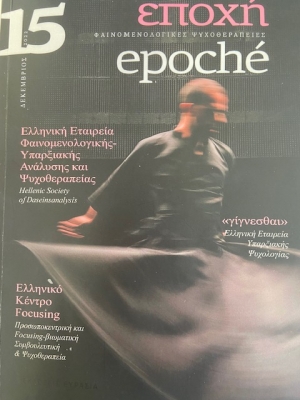
Σας ανακοινώνουμε ότι το κέντρο μας, Gestalt Foundation, ως κέντρο Ψυχοθεραπείας και Εκπαίδευσης της Φαινομενολογικής, Ολιστικής προσέγγισης Gestalt, προστέθηκε στο δυναμικό της ομάδας σύνταξης και έκδοσης του περιοδικού Εποχή / Epoché.
Το συγκεκριμένο περιοδικό είναι καρπός μιας συνεργασίας τριών εταιριών, του «γίγνεσθαι» (Ελληνική Εταιρεία Υπαρξιακής Ψυχολογίας), του Ελληνικού Κέντρου Focusing (Προσωποκεντρική και Focusing-βιωματική Συμβουλευτική και Ψυχοθεραπεία) και της Ελληνικής Εταιρείας Φαινομενολογικής-Υπαρξιακής Ανάλυσης και Ψυχοθεραπείας (Hellenic Society of Daseinsanalysis) και από το νέο του τεύχος και του Gestalt Foundation Κέντρο Ψυχοθεραπείας και Εκπαίδευσης.
Ο ρόλος του περιοδικού Εποχή / Epoché είναι να θέσει τον λόγο της ψυχοθεραπείας σε ενεργή συνομιλία με τους άλλους λόγους της κοινωνίας όπως τη φιλοσοφία, την τέχνη, την πολιτική, το λαϊκό αίσθημα, την επιστήμη κλπ. γιατί αυτός ο διάλογος φωτίζει και τον δικό της δρόμο.
Ο κοινός πυρήνας των κέντρων που συμμετέχουν υπογραμμίζει μια στάση: το πέρασμα από την ανελαστικότητα των μονοσήμαντων αληθειών στην αποδοχή του πολυσήμαντου και το περιοδικό Εποχή / Epoché φιλοδοξεί να είναι ένας ισχυρός εκφραστής μιας κουλτούρας που επιμένει να εμπνέεται από την αξία του γραπτού λόγου, ενός γραπτού λόγου που δεν κλείνει σε τελεσίδικες αποφάσεις αλλά διατηρεί ανοικτή τη δυνατότητα του ερωτήματος, συμβάλλοντας στην ώσμωση μέσω της συνάντησης και της συνομιλίας.
Σε κάθε τεύχος του θα βρείτε έναν σημαντικό αριθμό επιστημονικών άρθρων αλλά και άλλων λογοτεχνικών κειμένων, ποίηση, βιβλιοπαρουσιάσεις, ενημέρωση επιστημονικών εκδηλώσεων και πολλά άλλα ενδιαφέροντα.
Το περιοδικό είναι εξαμηνιαίο και εκδίδεται από τον εκδοτικό οίκο «Ευρασία» κάθε Ιούνιο και Δεκέμβριο. Το νέο τεύχος θα κυκλοφορήσει τον Δεκέμβριο του 2023.
Σας ευχαριστούμε για τον χρόνο σας και σας συστήνουμε να το ξεφυλλίσετε και να το απολαύσετε!!!